An Examination of Shadi al-Waisi’s Crimes and Hay’at Tahrir al-Sham’s Policies Toward the LGBTQI+ Community in Syria Before and After “Liberation”
Introduction
Amid attempts to imagine a Syrian geography free of violence and repression, an opposing discourse has emerged—one that openly boasts about physical and verbal assaults targeting LGBTQI+ communities inside Syria. This discourse is particularly visible in the reactions of virtual actors on social media, who reproduce an exclusionary reality devoid of empathy for the dignity of lives subjected to continuous violations. These abuses extend from the security apparatuses of the Assad regime to every actor who has come to wield power through arms or entrenched patriarchal authority.
This article does not approach LGBTQI+ rights and freedoms through a framework that treats queer people as exceptional groups defined by difference from a dominant society. Rather, the narrative centers on a fundamental reality: citizens—men and women alike—have faced, and continue to face, security and bodily violence that is either justified or tacitly tolerated by numerous armed and/or civilian revolutionary structures.
What Happened?
Since the fall of the Assad regime on 8 December 2024, a series of videos have circulated documenting armed men assaulting transgender individuals and forcibly raiding their homes across Syria, most recently in January. These videos—recorded and shared by the perpetrators themselves—depict extreme scenes of verbal humiliation and physical abuse carried out with weapons, accompanied by terrifying threats.
These violations occur in the absence of functioning judicial and legal systems in “new Syria.” Under the five decades of Assad rule, Syrian LGBTQI+ communities developed survival tactics to confront security and police repression, as well as societal violence. Some of these tactics proved effective due to accumulated experience with long-term abuse, even if they were never fully reliable. Today, however, as Syrians transition from one system of repression to another unfamiliar to large segments of the population who lived under Assad during the revolution, it becomes essential to revisit the historical practices of armed factions—including Hay’at Tahrir al-Sham (HTS), formerly Jabhat al-Nusra—to understand a reality that may shape decades to come.
Practices Under the Assad Regime
During the rule of Hafez and Bashar al-Assad, LGBTQI+ individuals were subjected to intense repression through legal, security, and direct incitement mechanisms. Legally, provisions of the Penal Code related to “public morals,” alongside Anti-Prostitution Law No. 10 of 1961, were used to prosecute LGBTQI+ individuals. Courts and public prosecutors reclassified charges under these laws to facilitate arrest and punishment.
Simultaneously, the government conducted organized campaigns against LGBTQI+ communities, with Bashar al-Assad himself playing a direct role. In 2021, he escalated hate speech by linking LGBTQI+ people to destructive foreign agendas and neoliberalism, triggering widespread arrests. These campaigns also included the confiscation of rainbow-colored toys and the repainting of colored staircases, aimed at erasing any symbols associated with gender and sexual diversity. Numerous human rights reports have documented the systematic use of sexual violence by security forces as a method of torture against detained LGBTQI+ individuals.
Practices of Armed Factions
Throughout the Syrian revolution and the escalation of armed conflict, numerous armed factions emerged, adopting varying degrees of socially conservative religious ideologies. In areas under their control, these factions imposed new legal realities, issuing execution orders that targeted many LGBTQI+ individuals living under de facto rule.
ISIS used executions as a tool of terror to impose its ideology. According to organizations monitoring LGBTQI+ issues in Syria, ISIS carried out at least 16 executions on charges related to homosexuality, employing methods such as stoning and throwing victims from high places.
Other armed groups were not exempt from similar practices. Over the past twelve years, various judicial bodies affiliated with de facto authorities were established across different areas of control.
Jaysh al-Islam, now incorporated into the reconstituted Syrian army, carried out executions targeting LGBTQI+ individuals between 2014 and 2017 during its control of Eastern Ghouta, based on rulings issued by the Eastern Ghouta Judicial Council.
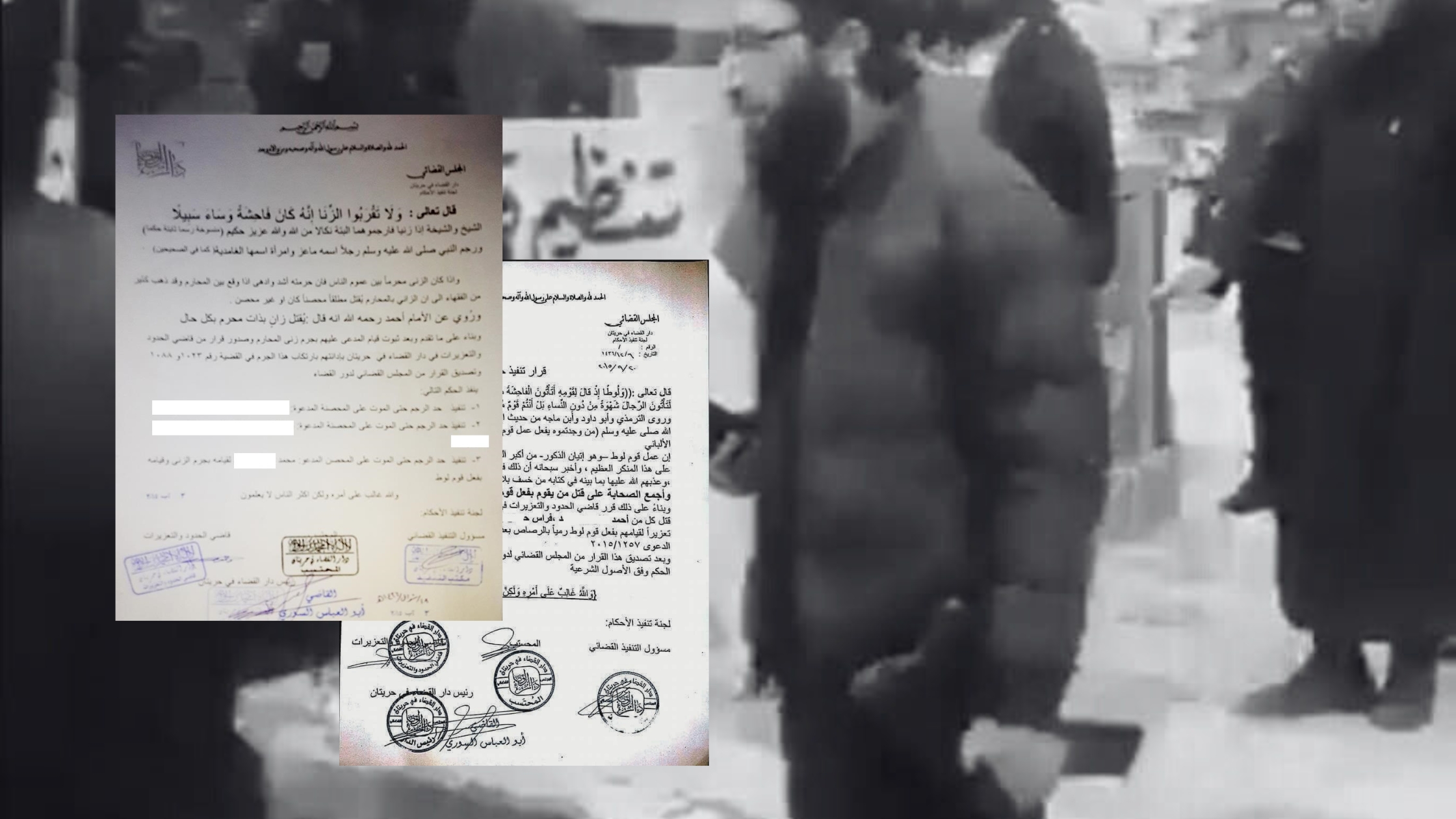
Similarly, the Supreme Judicial Court in Homs and its countryside, formed by armed factions including Jabhat al-Nusra (HTS’s former name), carried out a filmed execution of seven individuals in northern Homs countryside in 2015 on charges related to homosexuality.
A detailed table of documented executions based on sexual orientation follows (source: Out of the Shadows Study).
Practices of the Current Authority
Given the recent circulation of images documenting violations against transgender individuals in Rural Damascus and Latakia, it is crucial to examine the ideology governing the current authority and its security and judicial decision-making structures.
Over recent years, Hay’at Tahrir al-Sham—under the leadership of Ahmad al-Sharaa (formerly Abu Mohammad al-Jolani)—has undergone notable pragmatic transformations, shifting from a Salafi-jihadist faction under the name Jabhat al-Nusra to a more structured entity with a governmental façade represented by the “Salvation Government.” Despite these transformations, LGBTQI+ issues remain excluded from any meaningful change.
Shadi al-Waisi and Jabhat al-Nusra
One of the most prominent figures in the new Syrian government is Minister of Justice Shadi al-Waisi, who has been affiliated with Jabhat al-Nusra (later HTS) since at least 2015. Al-Waisi faced significant criticism after videos surfaced showing him overseeing the execution of women accused of adultery in northern Aleppo countryside and Idlib in 2015.
Born in Aleppo in 1985, al-Waisi holds a degree in Islamic jurisprudence. He began his career as a teacher and imam before joining the armed movement after 2011. He contributed to the establishment of Sharia courts in Aleppo, serving as a Sharia and criminal judge, appellate judge, and public prosecutor. He later headed several Sharia courts in Salqin, Hreitan, and the northern desert region.
Documents issued by the Hreitan Court record death sentences against four LGBTQI+ individuals, including detailed descriptions, dates, and signatures. A comparison of these signatures with those on official decisions issued after al-Waisi became Minister of Justice reveals a complete match. The signature—attributed to “Abu al-Abbas al-Souri,” al-Waisi’s nom de guerre—features the initials corresponding to his name. Further verification of official judicial pages shows engagement by the account “Abu al-Abbas al-Souri,” which includes photos of al-Waisi, biographical details, and confirmation of his identity.
Hay’at Tahrir al-Sham and the Salvation Government
The Syrian Salvation Government, HTS’s political arm, integrated Islamic law into its judicial system. Courts relied on individual judges applying personal interpretations of religious law, resulting in an inconsistent and difficult-to-analyze system.
In 2018, the Salvation Government’s Ministry of Interior detained six individuals in separate incidents before referring them to Sharia courts, without disclosing case outcomes. Human rights reports indicate that individuals accused of belonging to the LGBTQI+ community were detained under harsh conditions, with corporal punishment, including flogging, applied in some cases. Notably, HTS leader Ahmad al-Sharaa publicly reaffirmed his commitment to implementing “God’s law” in areas under Salvation Government control.
Conclusion
Syrian LGBTQI+ individuals living in Syria are not an anomaly within society; they are an integral part of it. They have endured the same displacement, repression, detention, and impoverishment experienced by all Syrians. Treating their lives as negotiable—whether through justifying violence, selective condemnation, or celebratory denial—is unacceptable.
This issue does not allow for speculation or debate. What is unfolding constitutes a fundamental threat to the principles of citizenship and equality, whether these violations are witnessed directly or merely heard about.
This understanding must go beyond reactive advocacy triggered only when new videos surface. It must also include sustained demands for non-selective transitional justice—one that does not merely redistribute power between center and margin, but actively dismantles the exclusionary structures that have kept marginalized communities under continuous repression for decades, and may do so for decades more if left unchallenged.

.svg)



.png)