How LGBTQI+ Rights Are Weaponized to Legitimize War, Occupation, and Racialized Violence
Homonationalism can be understood as an analytical framework that explains how nation-states—particularly in colonial and postcolonial contexts—incorporate certain LGBTQI+ rights into their national discourse, not as part of a project of comprehensive liberation, but as a mechanism for reproducing political and moral hegemony. Within this framework, LGBTQI+ rights are not advanced as part of an integrated social justice agenda; rather, they are selectively appropriated to serve the state’s self-narrative as “progressive,” “tolerant,” and “defenders of freedom,” while other societies—most often in the Global South—are portrayed as inherently repressive, backward, and hostile to queer people.
Homonationalism operates by redefining national belonging through gender and sexuality, such that the “acceptable gay subject” is one who aligns with neoliberal state values: individualism, consumption, the nuclear family, and military service. In contrast, queer bodies and identities that do not conform to this model—such as trans people, sex workers, refugees, or queer individuals engaged in anti-colonial or anti-capitalist struggles—are systematically excluded. In this sense, homonationalism does not eliminate exclusion; it reorganizes it internally.
In the context of the Global South, homonationalism takes on a distinctly geopolitical dimension. LGBTQI+ issues are instrumentalized to justify military interventions, economic sanctions, or political tutelage under the banner of “defending human rights.” This instrumentalization not only disregards the catastrophic consequences of such interventions for entire populations, but also reproduces the very violence it claims to oppose—including violence against LGBTQI+ individuals themselves. Here, rights are transformed from tools of liberation into a language that legitimizes violence.
Abu Ghraib Prison
The U.S. military committed documented sexual crimes in Abu Ghraib prison following the invasion of Iraq. Simultaneously, it promoted itself as a progressive institution by granting LGBTQI+ individuals the right to serve openly in the military. This narrative was reinforced through practices such as the circulation of racist and sexualized imagery in Pride marches—most notably an image depicting a white prison guard raping a doll representing Mahmoud Ahmadinejad with a nuclear missile—as well as the raising of the rainbow flag over the U.S. embassy in Baghdad. The erasure of sexual crimes, coupled with the portrayal of the U.S. military as tolerant, progressive, and protective of gay rights while combating “backward” forces in the Global South, constitutes a clear example of homonationalism.
Homonationalism is also grounded in a rigid epistemic and moral binary: the “progressive West” versus the “backward East.” Within this binary, the white gay man is positioned as a morally superior subject, while the Arab or Muslim man is constructed as an inherent source of sexual repression. This narrative does more than justify external intervention; it produces knowledge about the East as a space of perpetual moral failure, strips local struggles of their histories and complexities, and reduces queer subjects in the Global South to permanent victims in need of external rescue.
As a colonial tool in the twenty-first century, homonationalism does not rely solely on direct military occupation, but increasingly on cultural and epistemic domination. It imposes Western models of gender and sexuality as “universal,” marginalizing or erasing the local and historical frameworks through which societies in the region have understood identity, the body, and social relations. This epistemic imposition not only excludes non-Western experiences, but also redefines what counts as “liberation” and what is dismissed as “backwardness.”
The International Coalition: “White gays defending queer people of color”
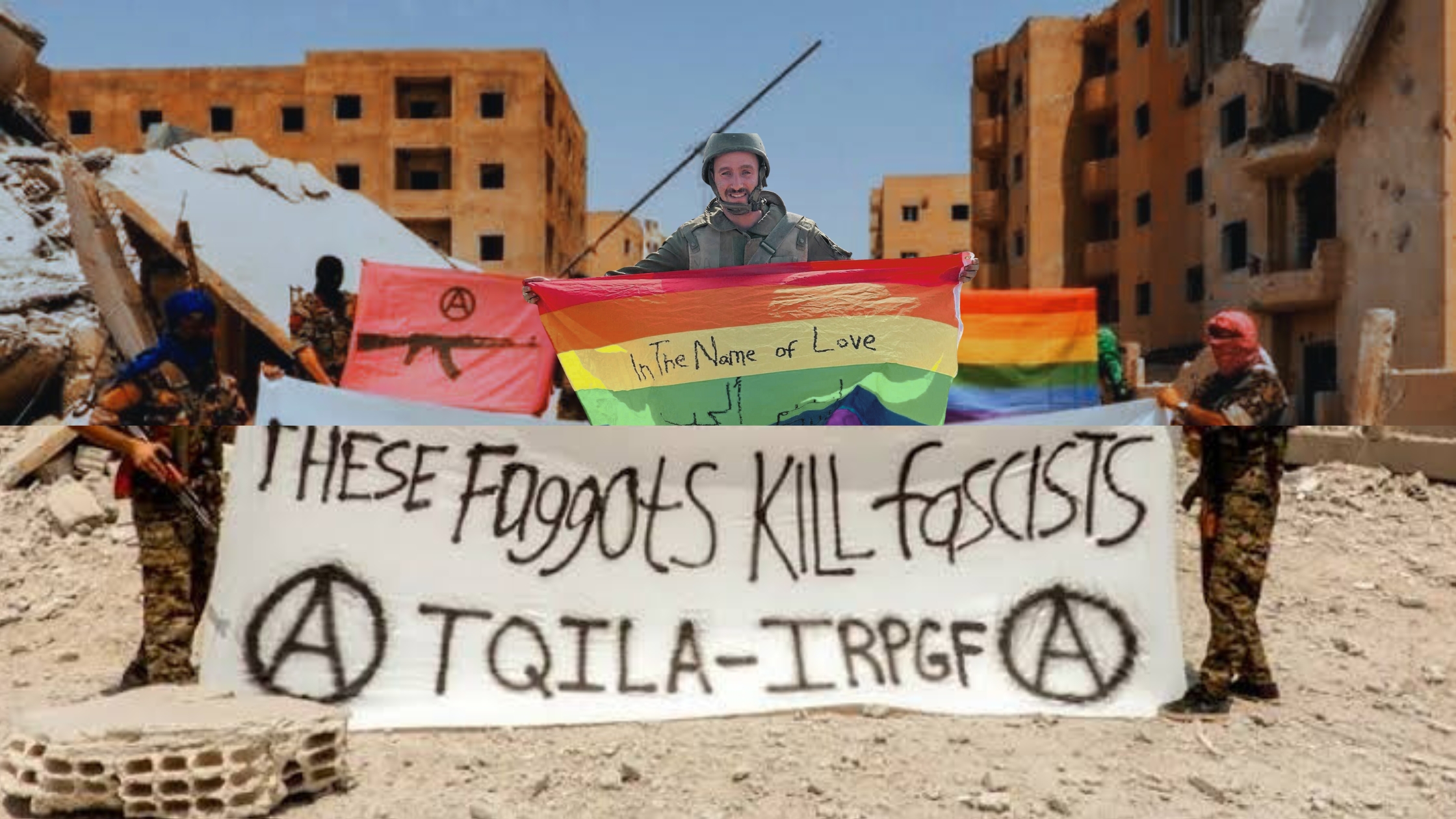
During the war between the international coalition and ISIS in Syria, images circulated of Western fighters holding rainbow flags against backdrops of destroyed cities. The use of LGBTQI+ rights to add a veneer of human-rights legitimacy to military interventions—despite the resulting destruction of infrastructure, displacement, and loss of life—is another manifestation of homonationalism.
The concept of homonationalism is deeply intertwined with pinkwashing, wherein LGBTQI+ rights discourse is used to divert attention from colonial, racist, or repressive practices. However, homonationalism goes beyond pinkwashing as mere media branding to become embedded within the structure of the state and its political discourse. It does not simply polish the image of the state; it actively reproduces violence by integrating “LGBTQI+ rights” into policies of exclusion, militarization, Islamophobia, and anti-Arab racism.
Gaza
(More than 100,000 people have been killed or injured—gay, lesbian, bisexual, trans, non-binary, intersex, queer; women, men, children; Muslim, Christian, atheist; even animals—in the name of love.)
Israeli authorities deploy LGBTQI+ rights discourse as part of a strategy to portray Israel as a progressive, democratic entity defending queer people in an “East” that allegedly persecutes them. This strategy includes the formation of LGBTQI+ community units that circulate images of themselves from Gaza. At the same time, the Israeli military publishes images of Palestinian men forcibly stripped and detained. This instrumentalization functions within a broader framework of Islamophobia and anti-Arab racism, advancing the logic that one is not killed for being queer, but for being Palestinian—an articulation that exemplifies homonationalism.
Confronting homonationalism does not mean rejecting LGBTQI+ rights; rather, it requires re-politicizing them and situating them within broader struggles against colonialism, racism, capitalism, and structural violence. It also necessitates dismantling the centrality of Western models of liberation and re-centering contextual frameworks, local experiences, and forms of queer resistance that have emerged within Global South societies—not as incomplete imitations of Western trajectories, but as fully formed projects of liberation in their own right.
In this sense, the central question shifts from how do we gain recognition from the state? to which state, which recognition, and at whose expense? And ultimately: can rights that are mobilized to justify killing and occupation truly be considered liberatory?

.svg)



.png)