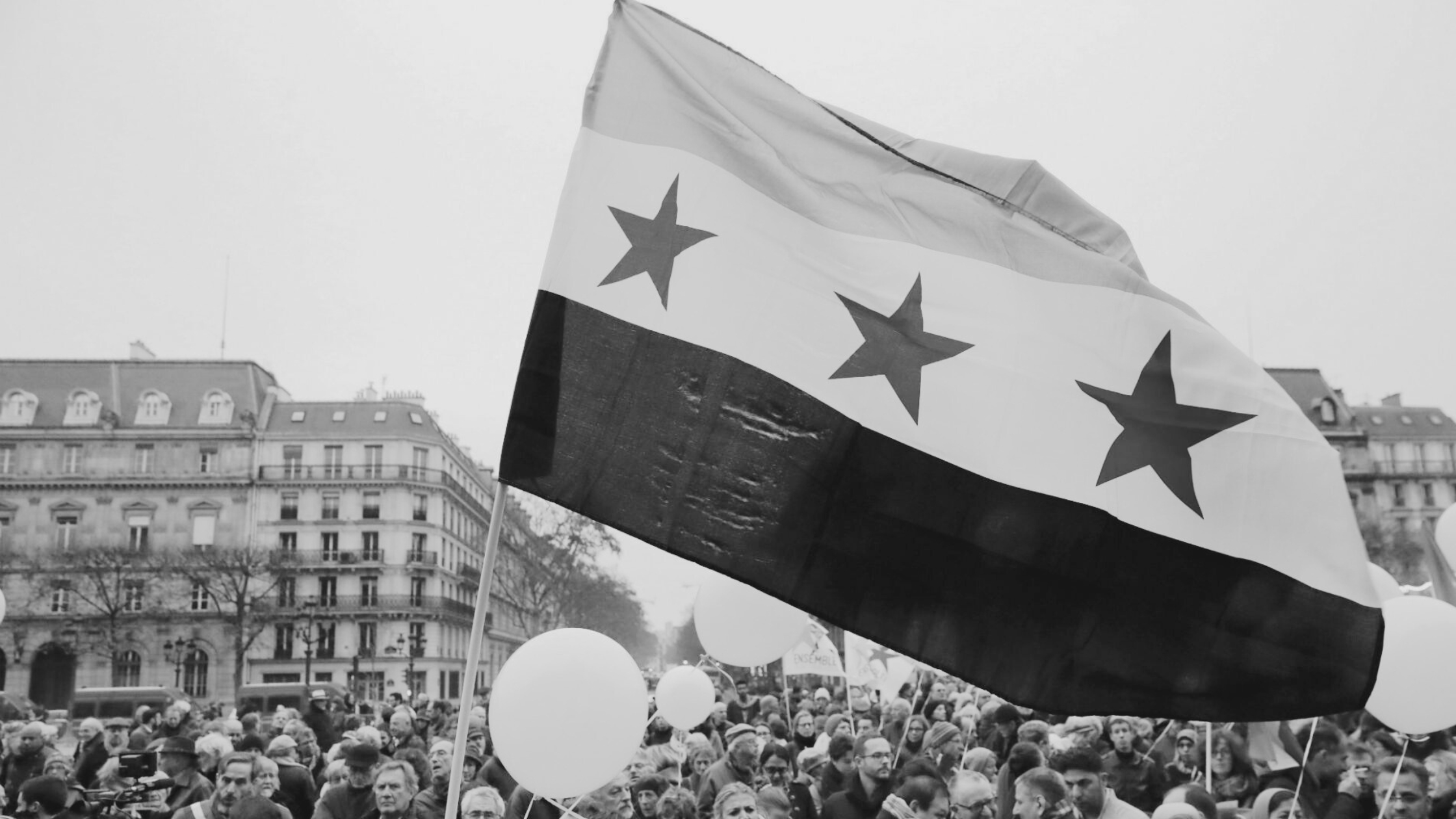
Despite their presence and participation in the uprising, queer voices were frequently marginalized and silenced within both regime and opposition discourses. “Homosexuality” was repeatedly weaponized during the Syrian revolution as a tool to undermine and discredit political opponents. Both the regime and opposition factions employed this tactic to stigmatize individuals and weaken their political influence. This practice reflects a broader pattern of using identities as scapegoats or targets in political संघर्ष.
The political exclusion faced by queer activists within the Syrian revolution—despite their participation in resistance movements—pushed many either to conceal their identities within revolutionary groups or to integrate into Syrian feminist movements as a safer political space.
Founding
The Syrian Queer Coordination for Supporting the Syrian Revolution was founded on 3 April 2011, following a gathering of queer Syrian individuals who had participated in a funeral protest for a group of martyrs in the city of Douma, in the Damascus countryside (April 2011). The idea of forming the coordination emerged spontaneously through discussions among its members about the realities of revolutionary organizing and coordination tools at the time, particularly given the existence of multiple coordination committees representing different social sectors.
For approximately two months, the coordination functioned as an inclusive organizing framework for diverse segments of the Syrian LGBTQI+ community. Its membership reached 21 individuals, largely through personal networks of friends and acquaintances within the community. Its activities were concentrated in Damascus and its countryside, as well as Homs.
Communication Under Surveillance
As security forces intensified restrictions on public gatherings from the early days of the revolution and imposed strict surveillance on phone lines and internet communications—going so far as to block text messages containing the names of cities or governorates—members of the coordination developed encrypted vocabulary to organize and call for demonstrations. These coded linguistic tools became essential for coordination under repression.
Activities and Objectives
Meetings among coordination members were held in small, dispersed groups across different physical locations—private homes in areas such as al-Muhajireen, Douma, and Homs, as well as public parks—to avoid gathering all members in a single place. These meetings focused on discussing the present and future of the Syrian revolution and coordinating participation in demonstrations and collective revolutionary activities.
Members of the coordination took part in multiple revolutionary actions. Their primary activities centered on organizing participation in demonstrations across various locations, in addition to smaller-scale protests known at the time as “flying demonstrations.” These actions included the distribution of leaflets printed by coordination members themselves. As Aram recounts:
“At first, we relied on printing leaflets at home, funding the process through donations from coordination members—especially trans sex workers who contributed their earnings to support printing. When we later faced difficulties affording ink and paper, we shifted to handwritten leaflets as a way to overcome financial barriers. These were distributed in the neighborhoods of al-Mazzeh, al-Muhajireen, al-Midan, and Old Zahira in Damascus, as well as al-Qusour and al-Malaab neighborhoods in Homs.”
Cessation of Work
From the outset of the Syrian revolution, anti-LGBTQI+ rhetoric was widely deployed through organized media campaigns beginning in 2011. These campaigns, led by Syrian regime-affiliated media outlets and political figures, accused political, military, and religious opposition actors of homosexuality as a means of delegitimization. This discourse continued in later regime-sponsored campaigns that framed LGBTQI+ issues as products of Western liberalism threatening “Eastern societies.”
In this context, Haneen—a transgender woman and one of the founders of the coordination—states:
“As individuals, members of the coordination faced serious risks, including arrest and death. Several members were arrested in 2011 and subjected to torture, including rape in one documented case. The coordination also lost martyrs in the struggle for freedom and liberation from tyranny—three activists were killed in Homs, two of whom were well known in revolutionary and media circles. However, we cannot name them, as doing so would amount to a symbolic execution of their martyrdom by stripping it of its revolutionary legitimacy.”
Hate speech was not limited to the Syrian regime. Certain revolutionary actors also engaged in exclusionary campaigns against LGBTQI+ participants in the revolution—even within some circles that identified as “progressive” and claimed to uphold principles of social justice. In many cases, queer identities were deliberately erased from the revolutionary narrative, either out of fear of societal backlash or due to deeply rooted homophobia and transphobia.
Aram describes one such incident:
“As a queer group, we faced direct exclusion. During a flying demonstration in Old Zahira, Damascus, in May 2011, after distributing leaflets demanding rights and equality for LGBTQI+ individuals, a member of the al-Midan coordination approached us and bluntly said, ‘Next time, we don’t want to see you here,’ clearly rejecting both our presence and our demands. Similarly, when one coordination member participated in producing documentation films about demonstrations and arrests in Damascus and its countryside, his attempt to record the arrest of one of his gay partners during a peaceful protest in al-Shaalan was explicitly rejected on the grounds that they did not recognize homosexuality or the participation of LGBTQI+ individuals in the revolution.”
After the Freeze
Following a wave of arrests targeting members of the group, the coordination suspended its activities, shut down its Facebook coordination groups, and halted meetings in order to protect remaining members from exposure. Nevertheless, individuals continued to participate in revolutionary activities independently. Haneen explains:
“After freezing the coordination’s work in June 2011 due to security risks, members did not withdraw from revolutionary action. They continued participating as LGBTQI+ individuals in many later peaceful activities, particularly those organized by the Syrian Nonviolent Movement, such as the Dignity Strike in December 2011, the theatrical performance in Old Zahira marking International Women’s Day on 8 March 2012, the release of ‘freedom balloons,’ peaceful demonstrations, and humanitarian relief work—especially following the systematic displacement of Homs’ residents.”
Documenting queer experiences within the Syrian revolution is not merely an attempt to prove queer participation or define their role. Rather, it exposes how various actors within binary power structures—regime versus opposition—actively sought to exclude queer voices from liberation struggles through moral accusations or revolutionary hierarchies that relegated sexual and gender issues to the margins.
Queer individuals have consistently found themselves marginalized within both revolutionary and state structures. This exclusion underscores the urgent need for multidimensional approaches to activism and resistance—approaches that recognize and address the diversity of experiences and identities within marginalized communities.

.svg)



.png)